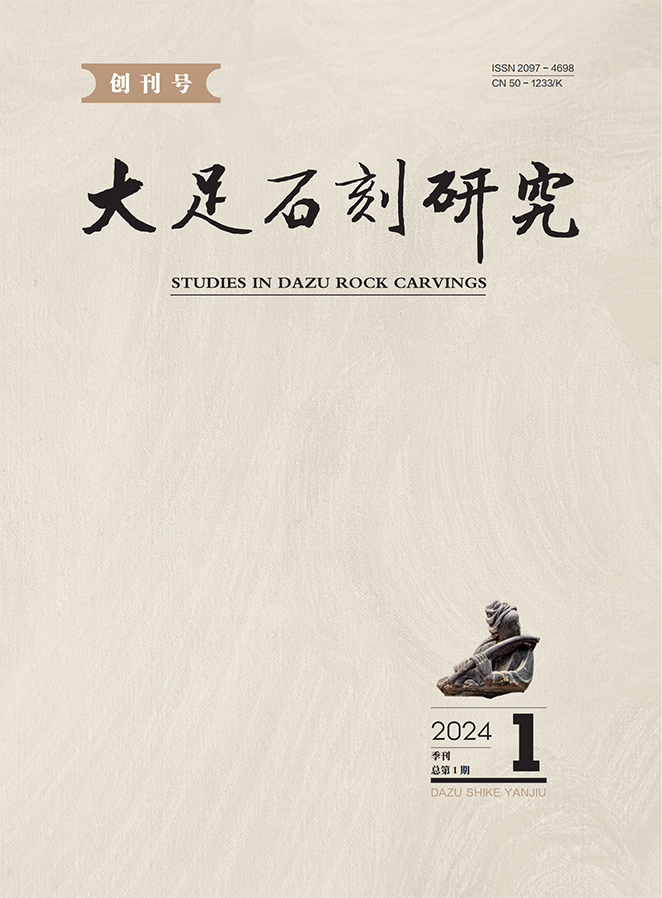
Highlights More
Collections
More +
Issue 3 
28 September 2026
  • Academy of Dazu Rock Carvings
    The main part of the Qianfoyan Rock Carvings was built between the 1st and 10th years of the Yongle reign of the Ming Dynasty (1403—1412). As a small grotto of the early Ming, it provides a well-defined chronological reference within the Dazu Rock Carvings. The 14 niches mainly focus on Pure Land belief, and thesubjects include the Twelve Light Buddha, the Three Saints of the West, the Illustration of the Amitayurdhyana Sutra, Thousand Buddhas, Ksitigarbha, Avalokitesvara, and the Seven Buddhas of the Past. The Qianfoyan Rock Carvings are of great academic value for refining the chronological sequence of the Dazu Rock Carvings and for the study of the spread of Pure Land belief, folk Buddhist art, and the transformation of grotto art in eastern Sichuan during the Ming Dynasty.
    Abstract ( ) Download PDF ( )
  • ZHAO Hong, YANG Chi, BAI Conglin, LEI Yuhua
    The Guangyuan Guanyinyan Cliff Carvings, located at a strategic point along the Jinniu Ancient Road,are divided into the South Cliff and North Cliff with a total of 131 niches, serving as an important Buddhist site of the Tang Dynasty in northern Sichuan. Based on the latest archaeological survey, through an examination of the cliff face, the statues can be classified into six groups according to the stratigraphic relationships of niches, sculptural features, and 26 dated inscriptions. The carving process can be divided into three periods and five phases, from the Kaiyuan era to the late Tang Dynasty. Two peaks and two declines in the carving activity can be identified with a clear developmental sequence. The donors were mainly composed of non-local merchant groups, which confirms its deep connection with the Shu Roads and its distinct folk-commercial nature.
    Abstract ( ) Download PDF ( )
  • MI Defang
    Since the rise of Liu Benzun’s Buddhism in the upper Yangtze River region in eastern Sichuan at the end of the 12th century, the practice of building statues and conducting rituals had become an important means of reaching local communities. The Illustrations of the Perfect Enlightenment Sutra is one of the popular themes in Chinese Buddhist art in the Song Dynasty. The adoption of this subject matter by Liu Benzun’s Buddhism, on the one hand, reflects its engagement with the religious culture and beliefs of the time; on the other hand, it demonstrates its emphasis on establishing its own identity and meanings during its spread among local communities.
    Abstract ( ) Download PDF ( )
  • ZHAO Shuangquan, SUN Tianke
    A total of 4 stupa-shaped burial niches have been discovered in Nanchong City, three in the Daxiangshan Grottoes and one in the Baishan Cliff Tombs, all dating to the Song Dynasty. The square recesses in these niches were mainly used for placing the remains of Buddhist devotees. The 18th niche in the Daxiangshan Grottoes was primarily built according to the Buddhosnisa Vijaya Dharani Sutra translated by Buddhapala. The body of the stupa was only engraved with mantras. This resulted not only from the trend toward simplification in sutra inscription at the time, but also from the height and number of sides of the stupa, as well as the important function of the mantras. The appearance of stupa-shaped burial niches is closely related to the prevalence of the hell belief at the time, the sutra’s role in breaking through hell, the functional zoning, and the use of funerary stupas.
    Abstract ( ) Download PDF ( )
  • LIANG Hong, SHA Wutian
    The periodization and dating of the late-period Dunhuang grottoes (including those from the late Cao, Shazhou Uyghur, Western Xia, and Yuan periods) have in recent years become both a focal issue and a major bottleneck in Dunhuang grotto research. Scholarly disagreements remain considerable, with some views even standing in complete opposition to one another. Why has such a situation arisen? A survey of existing scholarship suggests that four key factors underlie this problem: the chronological attribution of the green murals; the origins and development of Shazhou Uyghur art; the relationship between visitors’ inscriptions and grotto construction; and the relationship between the dating of unearthed materials from the Northern Section and the construction of Mogao Caves during the Western Xia and Yuan periods. Resolving these four issues is the key to removing the major obstacles to the periodization and dating of the late-period Dunhuang grottoes. Through careful analysis, it can be found that these problems are not complicated when approached from a scientific perspective. The much-debated green murals can be reasonably dated to the early Western Xia period; the relationship between Uyghur-style mural art and the green murals is in fact remarkably close; the large number of visitors’ inscriptions can only indicate the overall decline of the Dunhuang grotto complex and the terminus ante quem of the relevant grottoes; and the predominance of artifacts from the Western Xia, and especially the Yuan, unearthed from the Northern Section sufficiently demonstrates that large-scale grotto construction at Mogao had ceased by the Yuan Dynasty.
    Abstract ( )
  • GU Xinchun
    Located east of Nanchizi Street in Dongcheng District, Beijing, adjacent to the Forbidden City, Pudu Temple is an important Buddhist temple supported by the imperial family during the Ming and Qing Dynasties. This paper takes the revolving sutra repository at the southeast corner of the auxiliary hall of Ciji Hall in Pudu Temple as the research object: on the one hand, by placing it in the spatial context of the entire temple, and analysing the documentary accounts by visiting scholars during the Republican era and surviving historical photographs, we can reconstruct the internal structure and exterior decoration of this revolving sutra repository; on the other hand, through the identification and textual research of the marble balustrade of the revolving sutra repository, and by comparing it with the bronze Mount Sumeru at Yonghe Temple, it is found that the revolving sutra repository at Pudu Temple is a miniature model that replicates the Buddhist cosmic world through three-dimensional structure.
    Abstract ( ) Download PDF ( )
  • HAN Ming
    The water damage caused by humid and rainy environments has become a critical issue threatening the long-term preservation of cave temples in Sichuan and Chongqing. By integrating historical documents and cliff-surface relics, this study systematically reviews the traditional water-control measures adopted during the construction or restoration of cave temples in this region, revealing a scientific and systematic approach to addressing water damage. The research indicates that the core of traditional water-management wisdom lies in the holistic planning adapted to the cliff topography and the combined application of multiple measures. These methods can be categorized into three main types: the first is blocking, which involves constructing protective cave-eave structures, skillfully designing the roof forms of the niches, and digging internal drainage tunnels to physically isolate statues from direct water impact; the second is diversion and drainage, which entails scientifically building intercepting gutters, drainage channels, and underground conduits on the cliff surfaces and floors, both inside and outside the niches, to guide and discharge unintercepted surface runoff and seepage; the third is ingenious utilization, which integrates seepage points that are difficult to eliminate with iconographic themes (such as the Nine Dragons Bathing the Prince) or practical facilities (such as wells), thereby transforming water damage into scenic or functional value. These measures are not applied in isolation but are coordinated on the scale of the entire cave-temple complex, forming a three-dimensional waterproof network that extends from the cliff top to the cave interior, and from blocking to drainage. An in-depth study and reference to these traditional practices offer valuable insights for guiding contemporary conservation of cave temples, particularly in implementing the modern principles of holistic planning, site-specific adaptation, and minimal intervention in water damage management.

    Abstract ( ) Download PDF ( )
  • ZHANG Kai
    Artistic Research on the Images of Bashu Guanyin during the Tang and Song Dynasties takes the extant Guanyin sculptures in the Bashu region from the Tang and Song Dynasties as its research object. By building a systematic academic framework, the book deeply explains the key features of Bashu Buddhist art: its open and inclusive spirit, its innovative and local subject matter and iconographic patterns, and its utilitarian and syncretic religious practices. The study comprehensively employs methods from art history, archaeology, and quantitative analysis to reveal the free recombination of Guanyin iconographic programs, the maturation of regional styles, and original contributions. On this basis, it examines the history of civilizational integration from a micro perspective, highlights regional cultural subjectivity, reflects the spiritual landscape of society, and offers insights for the transmission and innovation of contemporary cultural heritage.
    Abstract ( ) Download PDF ( )
More +